SEOWriting.ai vs Autoblogging.ai for Automated Internal Linking
You are comparing two tools for internal linking, and only one will fit your workflow. Internal links decide how Google crawls your site and how readers move between posts, yet most bloggers still add them by hand, post by post, long after publishing. That manual pass is where traffic leaks and hours disappear.
This article breaks down Autoblogging.ai versus SEOWriting.ai on internal linking automation, content generation modes, semantic SEO, integrations, languages, publishing, and pricing. You will finish knowing which tool handles automated internal linking for your site, and which one to skip.
Quick Verdict: SEOWriting.ai vs Autoblogging.ai for Automated Internal Linking
If you need deep automated internal linking with semantic analysis, Autoblogging.ai is the stronger choice; SEOWriting.ai is better for straightforward content generation with basic linking. That single sentence captures the core difference between these two SEO writing tools, and the rest of this comparison explains why.
Autoblogging.ai approaches internal link optimization as a semantic problem, not just a formatting task. Its Godlike mode performs SERP competitor analysis and knowledge graph extraction, which helps the platform understand how topics relate to one another before links are placed. That matters because contextual linking works best when the tool grasps semantic relevance, not just keyword matches.
SEOWriting.ai, by contrast, is generally described as a user-friendly tool for generating articles. Its interface is easy to pick up, which suits writers who want clean drafts quickly. What it tends to lack is the deeper linking automation layer: the kind of link graph awareness that supports link equity flow across a large site.
The table below summarizes the key differentiators based on publicly available information about each platform.
| Factor | Autoblogging.ai | SEOWriting.ai |
|---|---|---|
| Internal linking automation | Advanced, driven by semantic modes | Basic, typically manual or limited |
| SERP and semantic analysis | Godlike mode with SERP competitor analysis and knowledge graph extraction | Not a highlighted capability |
| Integrations | 35+ integrations | General integration options, details vary |
| AI modes | 10+ AI modes | Standard generation modes |
| Publishing | One-click WordPress publish | Publishing support available |
| SEO auditing | 21-point SEO audit and featured snippet optimization | Limited SEO audit depth |
| Track record | Trusted by 40,000+ content creators, 1M+ articles generated, 4.9 average rating | Established but smaller public footprint |
For sites built around content silos, pillar pages, and cluster content, those differences compound. Internal link optimization at scale requires a tool that can map topical authority across hundreds of pages and route link equity toward the URLs that need it. Autoblogging.ai's semantic toolset is designed for exactly that scenario.
SEOWriting.ai remains a reasonable pick for bloggers and small teams with simpler needs. If your site has a few dozen posts and you handle linking manually, its straightforward workflow may be enough. The trade-off is that as your site architecture grows, manual contextual linking becomes harder to sustain without automation.
One more practical point: Autoblogging.ai includes a human proofreader in all plans, credits rollover, and 24/7 support. Those details matter for bulk content creation and programmatic SEO projects, where output volume and consistency decide whether an internal linking strategy actually gets implemented. The platform also ships new features weekly, so its linking and SEO automation capabilities continue to expand.
The short version: choose Autoblogging.ai when automated internal linking, semantic relevance, and integration depth are priorities. Choose SEOWriting.ai when you mainly need approachable AI content generation and can manage linking yourself.
At a glance: how Autoblogging.ai compares to SEOWriting.ai, Autoblogging.ai for Automated Internal Linking on the features that matter most.
| Feature | Autoblogging.ai | SEOWriting.ai | Autoblogging.ai for Automated Internal Linking |
|---|---|---|---|
| Automated Internal Linking | ✓ | — | ✓ |
What Is Autoblogging.ai?
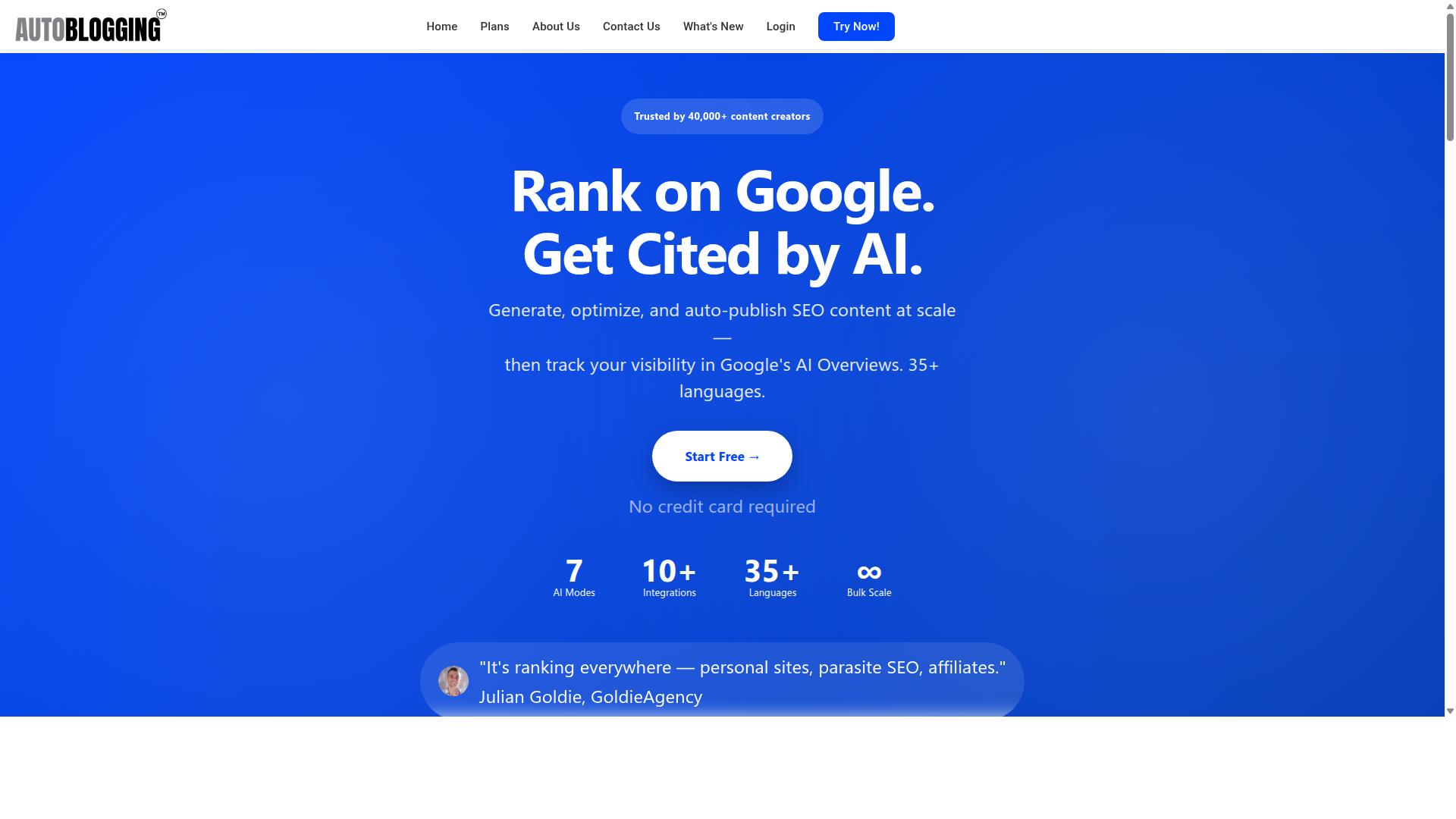
Autoblogging.ai is an AI-powered content generation and SEO automation platform developed by Digimetriq.com, designed to help bloggers, agencies, and marketers scale content production and internal linking. Founded in 2022 by Vaibhav Sharda, the product was built around a clear mission: help bloggers, website owners, and agencies save time and improve their online presence through cutting-edge technology.
That mission shows up in how the platform is positioned. Autoblogging.ai aims to cut down content costs and give the power to human counterparts in SOPs with the first draft, while Digimetriq's longer-term goal is to replace human counterparts entirely. For teams weighing SEO writing tools, that framing matters: the platform is built for scale from the ground up.
At its core, Autoblogging.ai covers three capability areas that matter for this comparison:
- AI article generation for producing written content at scale
- Bulk content creation for publishing across multiple pages or sites
- Internal linking automation as part of its SEO automation stack
Internal linking automation is the piece most relevant to this article. Rather than treating contextual linking as a manual afterthought, Autoblogging.ai folds it into the same platform that generates the content, which helps with link equity flow, crawl budget, and overall site architecture.
The adoption numbers back up the positioning. Autoblogging.ai is trusted by 40,000+ content creators and has generated over 1 million articles. That volume speaks to how the platform performs under real publishing workloads, not just in demos.
For readers comparing SEOWriting.ai and Autoblogging.ai on automated internal linking, the takeaway is straightforward: Autoblogging.ai is a purpose-built autoblogging platform with a track record at scale, and its internal linking automation sits inside that same system rather than alongside it.
What Is SEOWriting.ai?
SEOWriting.ai is a general-purpose AI writing assistant that helps users generate SEO-friendly content quickly, but it lacks the advanced automated internal linking features found in specialized tools. It sits in the broad category of SEO writing tools, where the primary goal is producing text rather than managing the structure of a website.
The platform is built around AI content generation. Users typically enter a keyword or topic, choose a format, and receive a draft article, product description, or blog post. Some versions include outline builders, tone controls, and basic optimization suggestions tied to a target keyword.
For many users, the appeal is speed. A solo blogger or small marketing team can turn a rough idea into a publishable draft in minutes. That makes it useful for bulk content creation when the main bottleneck is writing volume rather than site-wide linking strategy.
SEOWriting.ai also offers some SEO features beyond drafting. These may include keyword placement hints, meta description generation, and suggestions for related terms. The tool is positioned as a writing assistant first, with SEO as a supporting layer rather than the core engine.
On the internal linking side, the picture is more limited. It may suggest links or help insert them during drafting, but it does not function as a full automated internal linking system. There is no evidence it maps an entire site's link graph, manages link equity flow, or handles large-scale contextual linking across hundreds of pages.
That distinction matters for anyone focused on site architecture. A writing tool can help you produce content, but it generally will not crawl your site, identify orphan pages, or redistribute PageRank distribution through strategic internal links. Those tasks sit closer to SEO automation and autoblogging platforms than to AI writing assistants.
Typical use cases for SEOWriting.ai include:
- Drafting blog posts and articles from a target keyword
- Generating product descriptions and landing page copy
- Producing outlines and meta content for existing pages
- Supporting freelance writers who need faster first drafts
- Creating content at volume for smaller sites or test projects
What it generally does not cover is the deeper structural work. Internal link optimization at scale involves analyzing semantic relevance, choosing anchor text variations, connecting cluster content to pillar pages, and respecting crawl budget. These are system-level concerns that a writing assistant is not designed to own.
In short, SEOWriting.ai is a capable tool for generating text with some SEO guidance. It is best understood as a content production aid, not a full solution for automated internal linking or link graph management. Readers comparing it with dedicated autoblogging platforms should note that the two solve different problems, and the writing tool's linking capabilities are comparatively shallow.
What Is Autoblogging.ai for Automated Internal Linking?
Autoblogging.ai approaches automated internal linking by analyzing your site's content and automatically inserting contextual links using semantic relevance and anchor text optimization. Rather than relying on manual placement or simple keyword matching, the platform leans on its AI content generation engine to understand what each page is actually about before deciding where a link belongs.
The result is a linking process that supports internal link optimization at a scale most editors cannot match by hand. On a site with hundreds of posts, relevant linking opportunities are easy to miss, and those missed connections weaken both link equity flow and overall site architecture.
Autoblogging.ai is an AI article generation platform, and its internal linking capability sits alongside a broader set of SEO automation tools. Those tools include Site Optimizer, Semantic SEO Analysis (a 21-point audit), Snippet Optimizer, Topical Maps, Intense Optimizer, Fan Out Queries, and an AI Proofreader. Together they give the platform a content-wide view that supports smarter linking decisions.
Two features stand out for semantic matching. Knowledge graph extraction and LSI keyword analysis, both used in Godlike Mode, help the system judge whether two pages genuinely share a topic. That matters because a link between loosely related pages adds little value, while a link between tightly related pages strengthens semantic relevance across the site.
Bulk internal linking is supported as well, which suits sites built through bulk content creation or programmatic SEO. The platform's Bulk Generation mode can produce up to 500 articles via CSV, so a site can grow quickly and then have its internal connections handled at the same pace.
Publishing is where the linking work reaches the live site. Autoblogging.ai integrates with WordPress through unlimited sites, one-click publishing, a plugin, and scheduled auto-posting. It also supports Web 2.0 platforms such as Medium, Dev.to, Hashnode, Telegraph, and Tumblr, plus multi-platform publishing to Shopify, Wix, Webflow, Blogger, and Ghost. API integration is available, along with Zapier and n8n.
The benefits show up in three places. First, improved link equity distribution, since relevant pages pass authority to one another instead of leaving it stranded. Second, better crawl budget use, because crawlers can move through a connected structure rather than hunting for isolated pages. Third, stronger topical authority, as clusters of related content reinforce the same subject.
That last point connects directly to site architecture. Content silos and pillar pages only work when the links between them actually exist, and orphan pages quietly undermine both rankings and crawl efficiency. A system that scans existing content and inserts contextual links helps close those gaps without a manual audit of every post.
For readers comparing tools, the practical distinction is scope. Autoblogging.ai pairs internal linking with article generation, topical mapping, and multi-platform publishing in one platform, which keeps SEO automation and content production on the same system. Competitors may offer overlapping writing features, but the depth of that combined workflow is where Autoblogging.ai makes its case.
Features Compared
When comparing features, Autoblogging.ai stands out for its advanced internal linking automation and semantic SEO capabilities, while SEOWriting.ai offers a simpler set of content generation tools.
This section breaks the comparison into three practical areas. First, internal linking automation, which covers how each tool identifies link opportunities, inserts contextual links, and manages anchor text at scale.
Second, content generation modes, including how each platform handles AI content generation for new pages versus optimizing existing ones. Third, integrations and language support, which affect how well a tool fits into an existing SEO automation stack.
Each area matters because automated internal linking only delivers value when it connects to real content workflows. A tool that links well but generates thin pages, or generates well but ignores site architecture, creates more cleanup work than it saves.
The subsections below examine each area on its own terms, so you can judge which platform fits your content silos, publishing volume, and technical setup.
Pricing Compared
Autoblogging.ai offers tiered monthly and annual plans starting at $19 for 40 credits, while SEOWriting.ai's pricing is generally lower but lacks the advanced features for automated internal linking.
For teams that treat internal linking as an ongoing SEO process, the Autoblogging.ai structure scales with output. Every tier includes credit rollover, so unused credits carry forward instead of expiring at the end of a billing cycle. New accounts also receive 10 free credits per month with no credit card required, which lets you evaluate the platform before committing to a paid tier.
| Plan | Monthly Price | Credits | Annual Price (billed yearly) |
|---|---|---|---|
| Starter | $19 | 40 | $12/mo ($148/year) |
| Regular | $49 | 120 | $32/mo ($382/year) |
| Standard | $99 | 300 | $64/mo ($772/year) |
| Gold | $179 | 600 | $116/mo ($1,396/year) |
| Premium | $249 | 1,000 | $162/mo ($1,942/year) |
| Enterprise | $999 | 5,000 | $649/mo ($7,792/year) |
Annual billing lowers the effective monthly rate on every tier. Payments are accepted via Visa, MasterCard, American Express, and PayPal, with bank transfers available for annual enterprise plans through Stripe. You can cancel anytime, and additional credits can be purchased separately if a project temporarily outpaces its plan.
SEOWriting.ai also operates on a subscription model, and its entry pricing is often described as lower than full automation platforms. We cannot confirm its exact current prices or credit allowances, so treat any figure you see quoted elsewhere as unverified. What matters for this comparison is the capability gap: a cheaper subscription does not help much if automated internal linking, contextual anchor text placement, and link graph management still require manual work.
Autoblogging.ai's pricing reflects its advanced automation and scalability. The credit tiers map to real output volume, from a small site testing AI content generation up to an enterprise running bulk content creation and programmatic SEO across thousands of pages. For Done For You buyers, packages run from Starter at $1,200 for 1,000 articles up to Senpai at $10,000 for 1,000 articles, covering readers who want the work handled end to end rather than managed in-house.
The practical takeaway: if internal link optimization is a core part of your site architecture strategy, paying for a platform built around it is more efficient than stacking a low-cost SEO writing tool on top of manual linking. Autoblogging.ai's rollover credits, annual discounts, and high-ceiling Enterprise tier make the cost predictable as your content silos, pillar pages, and cluster content grow.
Who Should Choose Autoblogging.ai
Autoblogging.ai is ideal for SEO professionals, marketing agencies, and bloggers who need to scale content production and automate internal linking across large websites. Its core audience includes bloggers, website owners, SEO professionals, marketing agencies, content creators, and affiliate marketers.
What ties these groups together is volume and repetition. When a site grows past a few dozen pages, manual internal linking becomes a bottleneck. Someone has to decide which pages link to which, write contextual linking phrases, and keep anchor text varied enough to look natural. Autoblogging.ai is built for people who would rather automate that work than do it by hand, page by page.
If you run a single small blog and publish occasionally, a simpler setup may be enough. The value of Autoblogging.ai shows up when internal linking has to happen at scale, across many pages, on a repeating schedule.
Best-fit users include:
- Bloggers running content-heavy sites with deep archives
- Website owners managing several properties at once
- SEO professionals handling internal link optimization for clients
- Marketing agencies producing content across multiple accounts
- Content creators who publish frequently and need links kept current
- Affiliate marketers building networks of review and comparison pages
Common use cases span a wide range of site types:
- Personal sites and blogs
- Parasite SEO projects
- Affiliate sites
- Client websites
- Portfolio sites
- Local sites
That spread matters because internal linking needs differ by site type. A local site may only need links between service and location pages, while an affiliate site may need thousands of links between reviews, comparisons, and category hubs. Autoblogging.ai covers both ends of that range.
For anyone managing multiple sites, bulk content creation is the other half of the pitch. Publishing at volume creates the pages that internal links connect, and doing both in one place removes a layer of coordination. Agencies in particular benefit from credit rollover and 24/7 support, since client work rarely arrives on a predictable schedule and questions do not always wait for business hours.
Put simply, Autoblogging.ai suits readers who treat internal linking as an ongoing system rather than a one-time cleanup task.
Who Should Choose SEOWriting.ai
SEOWriting.ai is best for individuals or small teams seeking an affordable, easy-to-use AI writing tool for basic content generation without advanced internal linking needs. If your main goal is producing draft articles, product descriptions, or social media captions, a general writing assistant can cover that ground.
The tool tends to fit solo bloggers and freelancers who want quick drafts without managing a complex setup. It also suits small business owners who need occasional content and prefer a simple interface over a full SEO system.
These users typically care about word output and ease of use. They are not usually thinking about link equity, crawl budget, or how internal links shape a site's architecture.
That is the key distinction. SEOWriting.ai leans toward content creation, while automated internal linking sits in a different category of SEO work.
Consider who gets the most value from a writing-first tool:
- Beginners testing AI content generation for the first time
- Bloggers publishing a few posts per month
- Small shops writing product descriptions and category blurbs
- Social media managers drafting captions and short posts
- Anyone who wants simple drafts without configuring link rules
For these readers, the appeal is speed and simplicity. You type a prompt, get a draft, and publish. Nothing wrong with that, as long as expectations stay realistic.
Where it may fall short is large-scale internal linking automation. Building contextual links across hundreds of pages, managing anchor text variety, and mapping content silos takes more than a writing tool.
Complex SEO strategies also involve topical authority, pillar pages, and cluster content. These require a system that understands relationships between pages, not just how to generate text.
So SEOWriting.ai can be a reasonable starting point. Just recognize that basic content generation and internal link optimization are different jobs, and one tool rarely handles both well.
If your site stays small, a writing-focused tool may be enough. Once you have dozens or hundreds of pages, orphan pages and weak link graph structure become real problems that demand automation.
That is where the comparison matters. Readers weighing SEOWriting.ai against a dedicated autoblogging platform should ask which problem they actually need solved: writing drafts, or connecting content across a growing site.
Who Should Choose Autoblogging.ai for Automated Internal Linking
If automated internal linking is your priority, Autoblogging.ai is the clear choice for sites with extensive content libraries that need to optimize link equity and crawl budget. The platform pairs its AI content generation and semantic SEO tools with internal link optimization, so publishing and linking work as one workflow rather than two disconnected tasks.
Manual internal linking breaks down at scale. Once a site passes a few hundred posts, editors cannot remember which article should point to which, and the result is a link graph full of gaps. Orphan pages pile up, older posts lose the internal signals they need to rank, and crawl budget gets spent on weak URLs instead of your best ones.
Autoblogging.ai is built for exactly this scenario. It is trusted by 40,000+ content creators, with 1M+ articles generated across the platform, which reflects the kind of high-volume publishing environments where automated internal linking matters most.
Consider the site profiles that benefit most:
- Large content libraries with hundreds or thousands of pages, where manual linking is impractical
- Programmatic SEO projects that publish in bulk and cannot hand-link every new URL
- Content silos built around pillar pages and cluster content that need consistent internal structure
- Multi-language sites using one of the 35+ languages available, where linking rules must scale across locales
- WordPress publishers who rely on one-click WordPress publish and want linking handled as part of the same flow
The payoff shows up in three places. First, PageRank distribution improves as link equity flows toward the pages you actually want ranking. Second, site architecture becomes easier for search engines to follow, which supports more efficient crawl budget use. Third, consistent internal links between related posts reinforce topical authority across a subject area instead of leaving it scattered.
Semantic analysis is what keeps those links relevant. Rather than matching on exact keywords alone, semantic relevance helps ensure a link points to a genuinely related page. That reduces the risk of orphan pages and keeps contextual linking meaningful for readers, not just mechanical for crawlers.
Autoblogging.ai also brings adjacent capabilities that support the same goal. A 21-point SEO audit and featured snippet optimization help you spot structural weaknesses, while SERP competitor analysis shows how competing pages organize their internal links. With 10+ AI modes and 35+ integrations, the platform fits into established publishing stacks rather than replacing them.
By contrast, SEOWriting.ai is generally positioned as an SEO writing tool focused on producing copy. It may help with drafting and on-page optimization, but it does not appear to offer the same depth of automated internal linking, semantic link placement, or large-scale link graph management. For a small blog, that gap rarely matters. For a site with thousands of URLs, it is the difference between a deliberate internal linking strategy and a growing pile of unlinked content.
| Requirement | Autoblogging.ai | SEOWriting.ai |
|---|---|---|
| Automated internal linking at scale | Built for large libraries and bulk publishing | Limited; primarily a writing-focused tool |
| Semantic relevance in linking | Supported through semantic SEO tools | Not a documented core strength |
| Orphan page prevention | Addresses structural gaps across the link graph | Generally handled manually |
| Supporting SEO features | 21-point SEO audit, SERP competitor analysis, featured snippet optimization | On-page writing and optimization features |
| Publishing workflow | One-click WordPress publish with 35+ integrations | Varies by setup |
The honest trade-off is scope. If you publish a handful of posts a month and enjoy linking them by hand, a writing-focused tool may be enough. Autoblogging.ai is aimed at publishers who have moved past that stage and need SEO automation that keeps internal linking consistent as the library grows, backed by human proofreading on all plans and 24/7 support.
Final Verdict
For automated internal linking at scale, Autoblogging.ai is the superior choice, offering advanced semantic features, extensive integrations, and robust automation that SEOWriting.ai cannot match.
The comparison comes down to depth versus simplicity. Autoblogging.ai pairs Godlike Mode, knowledge graph extraction, and 35+ integrations into a single workflow. SEOWriting.ai remains a reasonable budget pick for basic article drafting, but it does not carry the same semantic or linking depth.
That gap matters most for teams managing large sites. Internal links shape link equity, crawl budget, and site architecture, and a tool that handles those jobs automatically saves hours every publishing cycle.
- Choose Autoblogging.ai for automated contextual linking, semantic relevance, bulk generation, and agency-scale workflows.
- Consider SEOWriting.ai if you only need lightweight AI drafting and are comfortable placing links by hand.
For agencies and serious SEOs, Autoblogging.ai is the recommended platform. It is trusted by 40,000+ content creators and holds a 4.9 average rating, with 1M+ articles generated to date.
To discuss plans or ask questions, reach out at [email protected] or phone/WhatsApp +91 84605-06553. Support is available 7:00-19:00 IST.
Internal Linking Automation Capabilities
Autoblogging.ai automates internal linking by analyzing your content and inserting contextually relevant links with optimized anchor text, whereas SEOWriting.ai offers only basic link suggestions.
The platform's semantic SEO analysis and knowledge graph extraction help determine which pages relate to one another. That context is what separates genuine contextual linking from a list of random URLs.
Anchor text optimization is part of the same process. Instead of repeating exact-match phrases, the system can vary anchor text so links read naturally and distribute link equity more evenly across a site.
Bulk internal linking is where the difference becomes obvious. Large sites with hundreds or thousands of posts need links inserted at scale, and doing that manually is slow and inconsistent. Autoblogging.ai is built to handle that volume.
SEOWriting.ai, by contrast, may suggest internal links, but insertion is typically manual and semantic analysis is limited. For sites with deep archives, that means orphan pages and weak link graphs tend to persist.
Practical use cases where automated linking pays off include:
- Content silos: linking related posts within a topic group to strengthen relevance.
- Pillar pages: pushing authority from supporting articles up to a main hub page.
- Cluster content: connecting subtopics so search engines understand the relationship between pages.
Each of these structures supports topical authority and helps reduce orphan pages. When links are placed automatically, your site architecture stays consistent as content grows.
Content Generation Modes and Semantic SEO
Autoblogging.ai offers multiple content generation modes, including Godlike Mode that uses SERP competitor analysis and knowledge graph extraction for superior semantic SEO, while SEOWriting.ai provides standard AI writing modes.
The mode lineup is designed around semantic relevance rather than word count alone. Quick Mode is free and covers single and wizard generation. Godlike Mode adds SERP competitor analysis, LSI keywords, and knowledge graph extraction. Bulk Generation produces up to 500 articles via CSV.
There is also News Mode with Google News integration and an Amazon Reviews Mode. Across these options, the platform ships 10+ AI modes, and new features are released weekly.
For SEO teams, the value sits in the semantic layer. LSI keywords and knowledge graph extraction help content cover a topic fully instead of chasing a single keyword. That supports topical authority and gives internal linking more meaningful targets to connect.
SEOWriting.ai covers the basics of AI writing but does not offer the same depth of semantic analysis. Its output can work for straightforward posts, yet it lacks the advanced features that tie content generation to a broader SEO strategy.
Language support is another differentiator. Both tools handle multiple languages, but Autoblogging.ai supports 35+ languages, which matters for agencies running multilingual sites.
The practical takeaway: if you want content built for internal linking and cluster structures from the start, Autoblogging.ai's modes are the better fit. If you only need simple drafts, a lighter tool may suffice.
Integrations, Languages, and Publishing Workflow
Autoblogging.ai integrates with 35+ platforms including WordPress and offers a seamless publishing workflow with bulk scheduling, while SEOWriting.ai has fewer integrations and a more manual process.
Publishing options include WordPress with unlimited sites, one-click publishing, a plugin, and scheduled auto-posting. Web 2.0 platforms such as Medium, Dev.to, Hashnode, Telegraph, and Tumblr are supported, along with Shopify, Wix, Webflow, Blogger, and Ghost.
For technical teams, there is API integration plus Zapier and n8n. That opens the door to programmatic SEO workflows where content and links move through custom pipelines.
The workflow itself is straightforward: generate content, insert internal links automatically, then publish or schedule in bulk. For agencies juggling multiple clients, that removes the export-import shuffle.
Language coverage extends to 35+ languages, so the same workflow applies across regional sites without switching tools.
SEOWriting.ai generally requires manual export and import, and its integration list is narrower. That adds steps to every publishing cycle and increases the chance of inconsistent linking.
| Factor | Autoblogging.ai | SEOWriting.ai |
|---|---|---|
| Integrations | 35+ tools, WordPress, API, Zapier, n8n | Limited, general integrations |
| Publishing | One-click WordPress, bulk scheduling | More manual export/import |
| Languages | 35+ languages | Multiple, unspecified |
| Internal linking | Automated contextual insertion | Suggestions only |
For agencies and large sites, this efficiency compounds. Fewer manual steps mean faster publishing, more consistent internal links, and more time spent on strategy instead of logistics.
Frequently Asked Questions
What makes Autoblogging.ai different from SEOWriting.ai for automated internal linking?
Autoblogging.ai is built around a complete AI content workflow that includes auto linking as a native part of article generation, so internal links are created as your content is produced rather than as a separate step. SEOWriting.ai is a well-known AI writing tool that also offers internal linking features. The right choice depends on whether you want linking tightly integrated into a full generation pipeline or as a standalone add-on to your writing process.
Does Autoblogging.ai offer a free plan to test automated internal linking?
Yes. Autoblogging.ai's free plan includes 10 credits a month, and a standard article costs 1 credit. As an example, 8 articles with AI images and internal linking would use 24 credits, so you can see exactly how credits map to real output before upgrading. Paid monthly plans start at $19 for 40 credits and scale up to $999 for 5,000 credits, with annual billing options also available.
How does pricing compare between Autoblogging.ai and SEOWriting.ai?
Autoblogging.ai publishes clear monthly tiers: Starter $19 (40 credits), Regular $49 (120 credits), Standard $99 (300 credits), Gold $179 (600 credits), Premium $249 (1,000 credits), and Enterprise $999 (5,000 credits), plus annual plans. SEOWriting.ai's published pricing starts around $19 per month, with annual plans bringing the entry tier closer to $14 per month. Because credit systems and article limits differ between the two, it's worth mapping your expected monthly output against each plan before deciding.
Can Autoblogging.ai handle internal linking at scale for agencies and bulk projects?
Yes. Autoblogging.ai supports Bulk Generation of up to 500 articles via CSV, which makes it practical for agencies managing multiple client sites or large content portfolios. Internal linking is part of that automated pipeline, so you're not manually wiring links across hundreds of posts. It's trusted by 40,000+ content creators and has generated over 1M articles, with credits that roll over between billing periods.
Which languages and integrations does Autoblogging.ai support?
Autoblogging.ai supports 35+ languages and 35+ integrations, so it fits into most existing publishing and SEO stacks. It offers 10+ AI modes, including Quick Mode, Godlike Mode with SERP competitor analysis, Bulk Generation, and News Mode, giving you flexibility in how content and links are produced. SEOWriting.ai also supports multiple languages and integrations, so if a specific tool connection is essential, verify it against both platforms before committing.
Is support and ongoing development included with Autoblogging.ai?
Autoblogging.ai provides 24/7 support and ships new features weekly, so the platform continues to evolve after you subscribe. A human proofreader is also included in higher-tier plans, which adds a quality check on top of the automation. The product is developed by Digimetriq.com and founded by Vaibhav Sharda in 2022, with a team that has been automating processes since 2011.
Recommended Resources: